We have 367 Japanese scrolls, ready to ship to you right now.
Japanese Scrolls for Sale
Sold Out $99.88
More Coming Soon




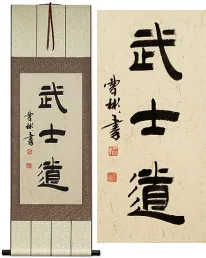
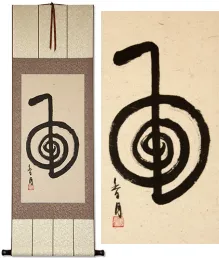


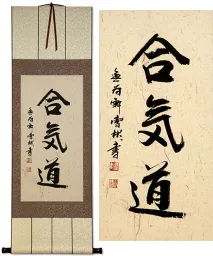
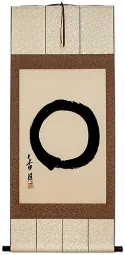


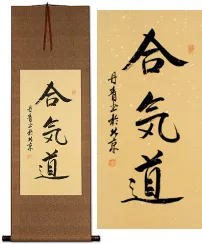
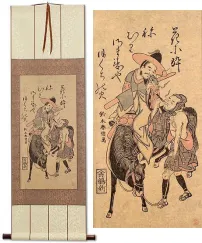
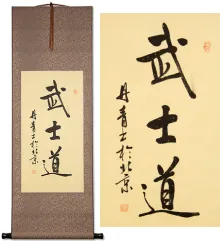
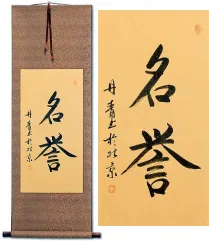



Sold Out $43.88
More Coming SoonDue to a military deployment, shipping will happen once a week until November 20th. News and More Info
We have 367 Japanese scrolls, ready to ship to you right now.
Sold Out $99.88
More Coming SoonSold Out $43.88
More Coming Soon14 Japanese calligraphy titles are available as custom-made wall scrolls. Choose your calligrapher, size, and other options.
Custom orders are typically delivered in several weeks.
You can customize and order a one-of-a-kind Japanese Scroll. Pick from the titles below to get started...
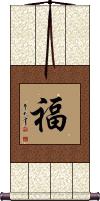
福 is pronounced “fu” in Chinese.
The character “fu” is posted by virtually all Chinese people on the doors of their homes during the Spring Festival (closely associated with the Chinese New Year).
One tradition from the Zhou Dynasty (beginning in 256 B.C.) holds that putting a fu symbol on your front door will keep the goddess of poverty away.
福 literally means good fortune, prosperity, blessed, blessedness, happiness, and fulfillment.
You'll also see this character in Vietnam (where Chinese characters were the written form until a romanization reform) where it is pronounced Phúc - a word commonly used in Vietnamese names because of its good meaning.
See Also: Serendipity / Lucky Coincidence
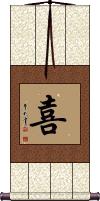
喜 is the Chinese, Japanese Kanji, and Korean Hanja for the kind of happiness known in the west as “joy.”
喜 can also be translated as rejoice, enjoyment, delighted, pleased, or “take pleasure in.” Sometimes it can mean “to be fond of” (in a certain context).
If you write two of these happiness/joy characters side by side, you create another character known in English as “double happiness,” which is a symbol associated with weddings and happy marriages.
There is another version of this character that you will find on our website with an additional radical on the left side (exactly same meaning, just an alternate form). The version of happiness shown here is the commonly written form in China, Japan and South Korea (banned in North Korea).
See Also: Contentment | Happiness | Joy
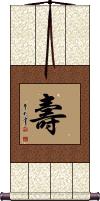
壽 can mean “long life” or “longevity” in the simplest form.
 Please note that Japanese use a simplified version of this character - it also happens to be the same simplification used in mainland China. Click on the character to the right if you want the Japanese/Simplified version.
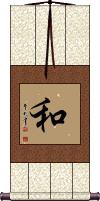
和 is the simplest form of peace and harmony.
和 can also be translated as the peaceful ideas of gentle, mild, kind, and calm. With a more harmonious context, it can mean union, together with, on good terms with, or on friendly terms.
Most people would just translate this character as peace and/or harmony. 和 is a very popular character in Asian cultures - you can even call it the “peace symbol” of Asia. In fact, this peace and harmony character was seen repeatedly during the opening ceremony of the 2008 Olympic Games in Beijing (a major theme of the games).
In old Chinese poems and literature, you might see this used as a kind of “and.” As in two things summed together. As much as you could say, “the sun and moon,” you could say “the sun in harmony with the moon.”
See Also: Inner Peace | Patience and Preparation | Simplicity
Samyag Vyayama / Samma Vayama
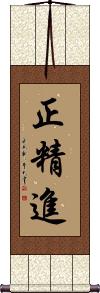
正精進 is one of the Noble Eightfold Paths of Buddhism. Right Effort, along with Right Mindfulness and Right Concentration, constitute the path to Concentration or Perfect Thought.
The proper effort is not the effort to make something particular happen. It is the effort to be aware and awake in each moment, the effort to overcome laziness and defilement, and the effort to make each activity of our daily meditation. This concept is about pursuing wholesome things that promote good karma.
Another definition: Cultivation of what is karmically wholesome and avoidance of what is karmically unwholesome.
This term is exclusively used by devout Buddhists. It is not a common term, and remains an unknown concept to most Japanese and Chinese people.
See Also: Buddhism | Enlightenment | Noble Eightfold Path
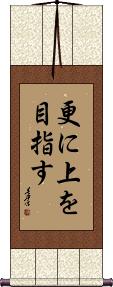
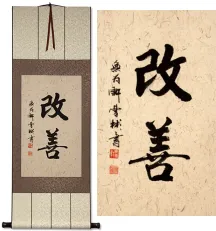
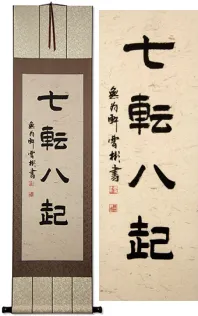
This Japanese proverb literally translates as: [After having achieved a fair degree of success,] one should still try to do better.
Others may translate this as “Always try to improve,” or “Always try to be better.”
Note: Because this selection contains some special Japanese Hiragana characters, it should be written by a Japanese calligrapher.
See Also: Never Give Up
Old Japanese / Traditional Chinese & Korean
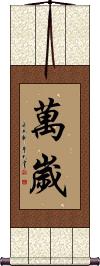
萬歲 is the traditional Chinese, Korean Hanja, and ancient Japanese way of writing banzai.
In modern times, the first character was simplified in Japan and China. So you might want to select the other entry for universal readability.
While it has become a popular, if not an odd, thing to scream as you jump out of an airplane (preferably with a parachute attached), banzai is actually a very old Asian way to say “hooray.” The Japanese word “banzai” comes from the Chinese word “wan sui,” which means “The age of 10,000 years.” It is actually a wish that the Emperor or the Empire live that long.
Imagine long ago when the Emperor made a rare public appearance. 萬歲 is what all people would yell to their leader in respect.
So if you like it as a hooray, or you want to wish someone that they live for 10,000 years, this is the calligraphy for you.
Other translations include Cheers! (not the drinking kind), hurrah!, long live [name]!, and congratulations!
To other things with banzai in their names, I am still waiting for the promised sequel to Buckaroo Banzai.
Notes: Sometimes people confuse banzai with bonsai. A bonsai is a miniature tree. They have nothing to do with each other.
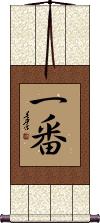
一番 is often used to mean “best” or “the best” in Japanese.
It actually means “number one” in Japanese.
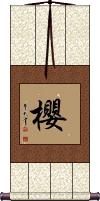
櫻 is the single-character (short) way to write “cherry blossom” or “cherry tree” in Chinese and traditional Japanese Kanji.
 There is an alternate version of this character, which has become the standard for Japanese Kanji. If you want this version, instead of the one shown to the upper left, please click on the Kanji shown to the right instead of the button above. Although this is an alternate form in Chinese, most Chinese people will think this is just the Japanese version (Chinese people
don’t
necessarily know the history and all alternate forms of Chinese characters from the past). Therefore, this version shown to the right is best if your audience is Japanese (though most Japanese will recognize the form shown in the upper left).
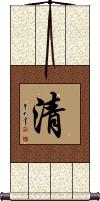
清 is a word that means clarity or clear in Chinese, Japanese Kanji, and old Korean Hanja.
Looking at the parts of this character, you have three splashes of water on the left, “life” on the top right, and the moon on the lower right.
Because of something Confucius said about 2500 years ago, you can imagine that This means “live life with clarity like bright moonlight piercing pure water.” The Confucian idea is something like “Keep clear what is pure in yourself, and let your pure nature show through.” similar to saying, “Don't pollute your mind or body, so that they remain clear.”
This might be stretching the definition of this single Chinese character but the elements are there, and “clarity” is a powerful idea.
Korean note: Korean pronunciation is given above but this character is written with a slight difference in the “moon radical” in Korean. However, anyone who can read Korean Hanja, will understand this character with no problem (this is considered an alternate form in Korean). If you want the more standard Korean Hanja form (which is an alternate form in Chinese), just let me know.
Japanese note: When reading in Japanese, this Kanji has additional meanings of pure, purify, or cleanse (sometimes to remove demons or “exorcise”). Used more in compound words in Japanese than as a stand-alone Kanji.
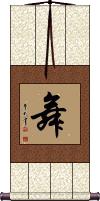
舞 is the simplest way to write dance in Chinese, Japanese Kanji, and old Korean Hanja.
It can also be translated as to dance, to wield, to brandish, or to circle.
舞 reads more clearly as dance in Chinese than it does in Japanese (see our two-character word for dancing if you want to be absolutely clear in both languages).
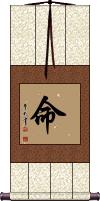
命 is often translated as “destiny.”
Sometimes this character is simply translated as “life” but more in terms of one's lot in life. In a certain context, this can mean command or decree (generally from a king or emperor). Of course, such a decree is part of fate and leads you to fulfill your destiny.
In Chinese, this word leans toward the fate or destiny definition.
In Korean, it is usually read simply as “life.”
In Japanese, it can mean all definitions shown above, depending on context.
See Also: House of Good Fortune
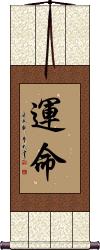
These two characters contain the ideas of fate, destiny, fortune, and luck in Chinese, Japanese Kanji, and old Korean Hanja.
運命 is often defined as “a person's fate” or “personal fate” in various dictionaries.
These two characters can be reversed (written in either order) and yield roughly the same meaning.
This particular character order is more common in old Korean and less common in modern Chinese.
See Also: House of Good Fortune | Good Luck
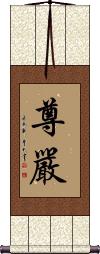
尊嚴 is a form of honor that means showing great respect for yourself, other people, and the rules you live by.
When you are honorable, you keep your word. You do the right thing regardless of what others are doing.
尊嚴 is the kind of personal honor or dignity that is of great value. If you lose this, you have lost yourself and perhaps the reputation of your family as well.
While this is not directly the same thing as “face” or “saving face” in Asian culture, it is associated with the same concept in China.
 In Japan, they currently use a more simplified second character for this word. The ancient Japanese form is the same as China but after WWII some Kanji were changed. If you want the modern Japanese version, just click on the Kanji image shown to the right, instead of the button above.
All of our calligraphy wall scrolls are handmade.
When the calligrapher finishes creating your artwork, it is taken to my art mounting workshop in Beijing where a wall scroll is made by hand from a combination of silk, rice paper, and wood.
After we create your wall scroll, it takes at least two weeks for air mail delivery from Beijing to you.
Allow a few weeks for delivery. Rush service speeds it up by a week or two for $10!
When you select your calligraphy, you'll be taken to another page where you can choose various custom options.
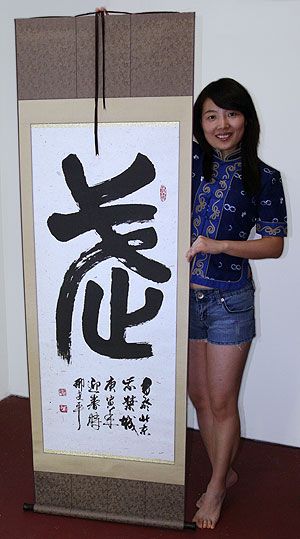
The wall scroll that Sandy is holding in this picture is a "large size"
single-character wall scroll.
We also offer custom wall scrolls in small, medium, and an even-larger jumbo size.
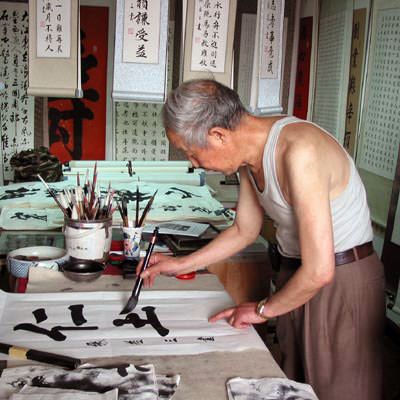
Professional calligraphers are getting to be hard to find these days.
Instead of drawing characters by hand, the new generation in China merely type roman letters into their computer keyboards and pick the character that they want from a list that pops up.
There is some fear that true Chinese calligraphy may become a lost art in the coming years. Many art institutes in China are now promoting calligraphy programs in hopes of keeping this unique form
of art alive.
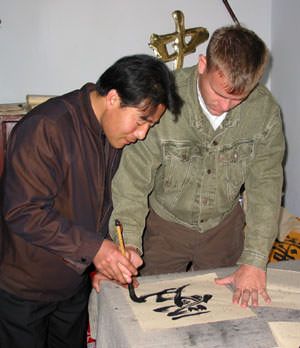
Even with the teachings of a top-ranked calligrapher in China, my calligraphy will never be good enough to sell. I will leave that to the experts.
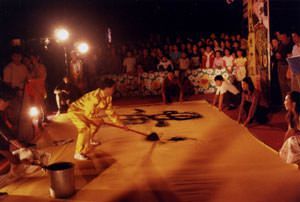
The same calligrapher who gave me those lessons also attracted a crowd of thousands and a TV crew as he created characters over 6-feet high. He happens to be ranked as one of the top 100 calligraphers in all of China. He is also one of very few that would actually attempt such a feat.